
If you've ever deployed an internal tool to your organization using Retool, you've encountered the "Viewer Tax" — the moment when your brilliant automation suddenly becomes a budget line item multiplied by headcount.
A dashboard that helps 500 customer support agents? That's not a $99/month tool. That's a $49,500/year commitment. An ops tool your entire warehouse team needs? Better start counting heads.
We built Build0 with a different philosophy. Not because we've found a way to make infrastructure free - we haven't - but because we believe per-seat pricing creates the wrong incentives for internal tools.
The Problem with Per-Seat Pricing
Per-seat pricing makes sense for some software. Figma charges per designer because each designer gets dedicated value. Slack charges per user because each user consumes messaging infrastructure.
But internal tools are different. When you build a dashboard for your support team, the value isn't in how many people can view it - it's in the decisions it enables, the time it saves, the errors it prevents.
Per-seat pricing for internal tools creates perverse incentives:
Limit distribution to control costs - that warehouse dashboard? Maybe only supervisors get access
Build fewer tools - every new tool multiplies your seat count problem
Avoid self-service - better to have one person run reports than give everyone access
You end up optimizing for fewer users instead of more impact.
How Build0 Actually Works
Let's be clear about what happens when you publish a Build0 app:
Your app deploys to our infrastructure - we host it on our Vercel account
End-users authenticate through our system - we handle identity for published apps
Database and integration traffic flows through us - credentials are secured and proxied via our API
We serve every request- when your 500 support agents load that dashboard, our servers respond
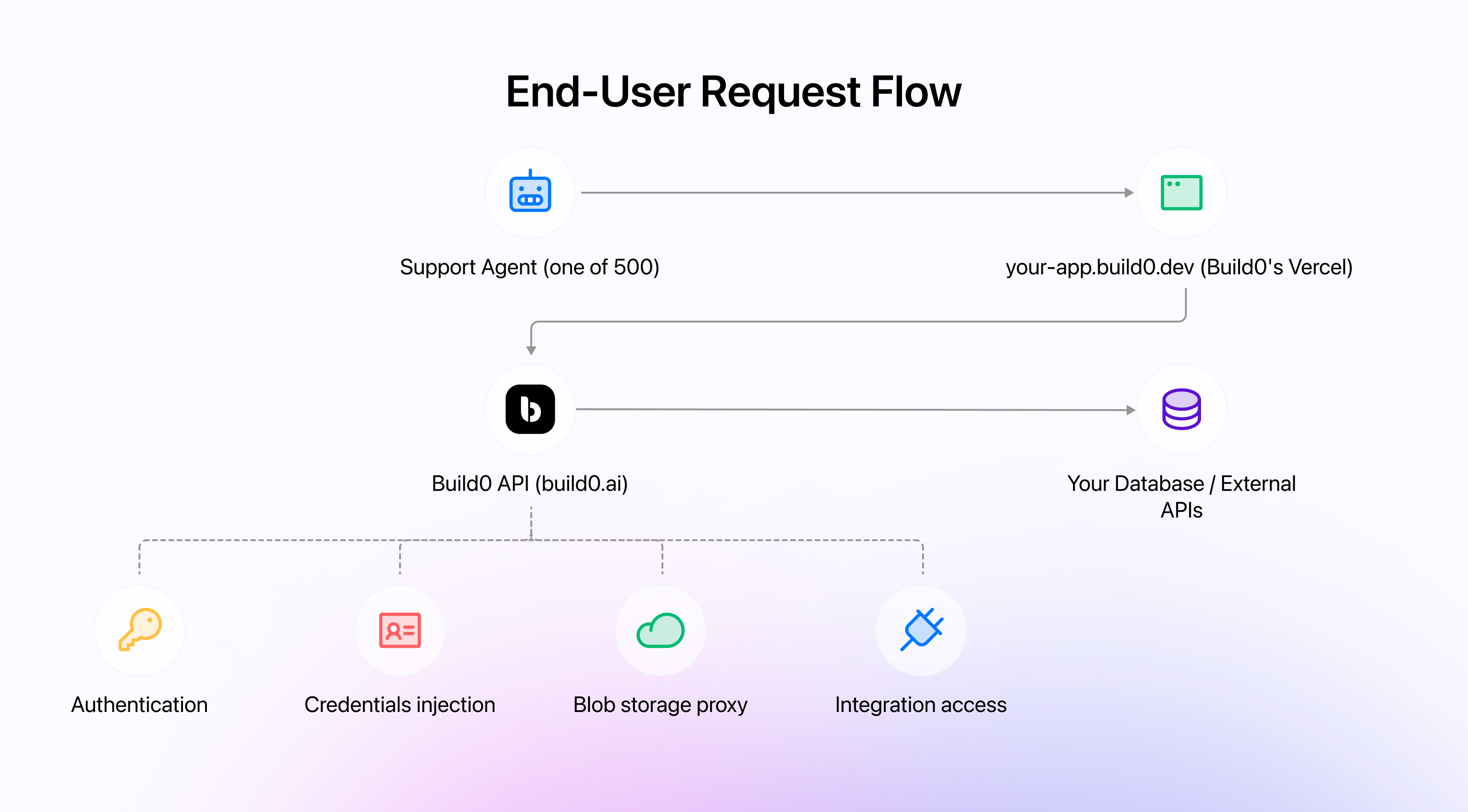
We're not passing infrastructure costs to a third party. We're absorbing them.
So why don't we charge per viewer? Because we think there's a better way to align our business with your success.
Our Pricing Philosophy
We charge for monthly subscription for a platform that can create customized software, not for using.
Plan | Viewers | Apps | Price |
|---|---|---|---|
Free | 0 | 2 | $0 |
Team | 10 | 5 | $35/mo |
Growth | 30 | 10 | $75/mo |
Scale | 90 | 20 | $149/mo |
Enterprise | Unlimited | Unlimited | Flexible |
For each subscription tier, you're provided credits that should be enough to build useful tools for your organization size. Then, you pay a fixed, predictable monthly fee to use the tool, just like the subscription fees you pay for other SaaS products. The credits are refreshed every month in case you want to make incremental updates to the customized tool.
The logic:
Your support dashboard took 10,000 credits to build → 500 agents use it daily → You pay for access to the dashboard , not for the 500 agents
This means your cost is tied to the value you get from Build0, not organizational headcount.
What About Infrastructure Costs?
Fair question. If we're serving requests for your 500 support agents, we're incurring real costs. How does that work?
Today: We absorb these costs as part of your subscription. The difference between a Team plan customer with 10 users and one with 500 users is margin, not revenue. We're betting that the value we provide in development speed justifies flat-rate pricing.
Tomorrow: As we scale, we may introduce usage-based components for high-traffic applications:
Execution time for compute-intensive operations
Request volume for high-QPS applications
Storage and bandwidth for data-heavy apps
But here's the key difference: usage-based pricing is not seat-based pricing.
If your app serves 500 users making 10 requests each, you'd pay for 5,000 requests - not 500 seats. If those same 500 users make 2 requests each, you'd pay for 1,000 requests. Your cost scales with actual infrastructure consumption, not with how many names are in your org chart.
The Incentive Alignment
Let's compare the incentives:
Per-seat model (Retool) | Development-based model (Build0): | Potential usage-based model (future Build0) |
|---|---|---|
Vendor profits when you add users | Vendor profits when you build more apps | Vendor profits when apps are heavily used |
You profit when you limit users | You profit when your apps get widely used | You profit when apps deliver value worth the usage cost |
Conflict: you want to restrict access, they want you to expand it | Alignment: we both want you to build valuable tools that spread through your organization | Alignment: we both want apps that are worth running |
In no scenario do we profit simply from you having a large organization. We profit when you're growing and scaling the tools you create on Build0, or when what you've built is actively delivering value.
When Does This Matter Most?
Internal Tools with Wide Distribution
The classic viewer tax scenario: tools that many people need to access but few need to modify.
Operations dashboards
Customer support tools
Inventory management
Reporting interfaces
Approval workflows
These are exactly the tools where per-seat pricing hurts most. You're not giving 500 people Photoshop-level creative capabilities - you're giving them a window into data they need to do their jobs.
Public-Facing Applications
Build0 supports public access for published apps. Enable it, and anyone with the link can use your app without authentication.
Customer portals, partner dashboards, public data tools — all without counting external users as "seats."
Rapid Prototyping and Experimentation
When every new tool multiplies your seat licensing, experimentation gets expensive. With Build0, you can spin up ten prototypes, let your team try them, and only pay for the development time - not for the organizational curiosity.
What We're Not Saying
Let's be honest about the trade-offs:
We're not saying infrastructure is free. We incur real costs when your apps serve traffic. We've chosen to absorb those costs today and may price them explicitly tomorrow.
We're not saying Retool is wrong to charge per seat. They've built a large business on that model. Per-seat pricing is predictable for both vendor and customer, and it's accepted in enterprise SaaS.
We're not saying we'll never raise prices. If our costs scale faster than our revenue, we'll need to adjust. But at least for now, we think this benefits our customers more!
The Bottom Line
The viewer tax isn't inevitable. It's a choice.
Retool chose per-seat pricing because it's a proven enterprise model and profitable.
We chose growth-based pricing because we believe internal tools should spread freely through organizations, and because we'd rather provide predictable, transparent cost to our customers.
Both models can work. But if you've ever looked at a per-seat calculator and wondered whether you could really justify giving that dashboard to the whole team - we built Build0 for you.